
Available for orders from 15 Feb 2026.
For decades, the technology industry has been obsessed with “The End of History.” Every few years, a new innovation arrives with a digital scythe, promising to reap the souls of the world’s IT service providers. We saw it with the Y2K bug—where critics predicted a post-2000 wasteland for Indian tech. We saw it with the Software-as-a-Service (SaaS) explosion, where “off-the-shelf” was supposed to mean “out-of-a-job” for engineers. And now, as Anthropic releases tools that can navigate a computer like a human, the eulogies are being written once again. But here is the irony: The more powerful the tool, the more complex the workshop. The narrative that AI agents will “kill” IT services ignores the fundamental law of digital entropy. As we automate the simple, we reveal the terrifying complexity of the structural. We aren’t witnessing the death of an industry; we are witnessing a full scale reboot of how value is created in the global economy.
When Anthropic released its latest suite of AI agents—capable of managing legal compliance, drafting code, and navigating complex UIs—the markets reacted with a predictable shudder. Shares in global IT giants dipped. The logic seems sound: if an AI can act as a “junior lawyer” or a “coding assistant,” why do you need 500,000 humans in Bengaluru or Pune?
To understand why this logic is flawed, we have to look at the Aviation Metaphor.
In the early days of flight, a pilot’s job was visceral and manual. They felt the tension in the wires; they adjusted the flaps by hand. When the autopilot was invented, many predicted the end of the pilot. Today, modern long-haul jets are essentially flying servers. The “autopilot” does 90% of the work. Yet, we have more pilots than ever before. Why? Because the role shifted from manual operator to systems manager.
When the system fails at 35,000 feet, you don’t want a better algorithm; you want a human who understands the context of the failure. IT services are the pilots of the enterprise. The AI agent is the autopilot. It can handle the steady state, but it cannot navigate the storm of legacy debt, fragmented data, and conflicting corporate interests.
To navigate this new era, we must move beyond the “efficiency” conversation. The real value lies in the Agentic Advantage Framework. This is a three-tier evolution of how services are delivered:
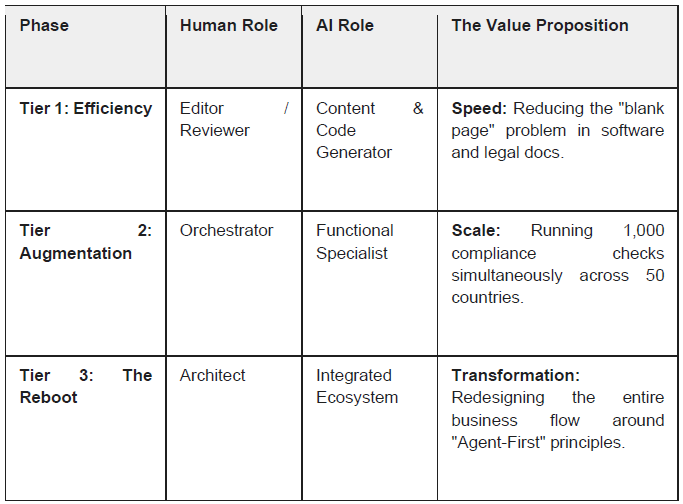
Most are stuck looking at Tier 1. They see a 30% rise in coding efficiency and assume that means 30% fewer people. But history shows that when you lower the cost of a resource (in this case, “intelligence”), the demand for that resource doesn’t stay flat—it explodes.
A decade ago, the “SaaS Revolution” promised that enterprises could just buy Salesforce or Workday and fire their IT departments. No more servers to maintain, no more custom code.
What actually happened? Enterprises bought too many SaaS tools. Suddenly, the HR tool couldn’t talk to the Finance tool. The data was siloed. Security became a nightmare. The “engineers sitting and writing code” didn’t disappear; they became Integration Architects. They were needed to stitch the cloud together, to manage the “sprawl,” and to ensure that a software update in one department didn’t crash the database in another.
AI agents will follow the exact same trajectory, but with higher stakes. If a SaaS tool fails, a button doesn’t work. If an AI agent fails, it might hallucinate a legal clause that costs a company billions, or “fix” a production database by deleting it.
The “Middle of the Night” Rule: No CEO is going to trust a mission-critical, regulated banking system entirely to a black-box AI. When the system corrupts data at 3:00 AM, you need a vendor who can diagnose, fix, and—most importantly—take accountability. You cannot sue an algorithm.
Think of the current state of IT as a massive construction project. For years, the industry was paid to lay bricks (writing lines of code). AI agents are essentially “automated bricklayers.” They are faster, cheaper, and don’t get tired.
Does this mean we stop building cities? No. It means we can finally afford to build better cities.
When the cost of laying a brick goes to near-zero, the focus shifts to the Architect and the Urban Planner. We start asking: How should the city be designed? How do we ensure the plumbing (data) and the electricity (security) support the new structures?
The “Full Scale Reboot” means moving away from selling “man-hours” to selling “architectural integrity.” Indian IT has already proven it can make this leap. Between 2014 and 2024, as the cloud was supposedly “disrupting” them, their revenue grew from $118bn to nearly $300bn. They didn’t grow by writing more basic code; they grew by managing the terrifying complexity of the Cloud Migration.
There is a dirty secret in the AI world: AI is only as good as the data it eats. Most enterprise data is “dark data”—fragmented, unformatted, and often flat-out wrong.
An AI agent dropped into a typical Fortune 500 company is like a Ferrari dropped into a swamp. It’s a magnificent machine that isn’t going anywhere. Someone has to:
This “pre-work” and “oversight-work” is massive. It is labor-intensive, domain-specific, and requires a deep understanding of the client’s business. This is the new “Agentic Advantage”—being the firm that makes the AI actually work in the real world.
We often talk about technology as if it exists in a vacuum. It doesn’t. It exists in a human ecosystem.
One of the most remarkable aspects of the IT services model—particularly in hubs like India—is the “Reskillability Index.” When Y2K ended, those engineers didn’t retire; they learned Java. When Java became commoditized, they learned Cloud and Mobile. Today, firms are training hundreds of thousands of employees on AI prompts and agent orchestration.
This is the Biological Metaphor. A species that can adapt its DNA to a changing environment doesn’t go extinct; it evolves. The IT services industry is the most adaptive “species” in the corporate world. They are currently building their own AI platforms not to replace their people, but to give their people “Exosuits.”
The headline shouldn’t be “AI Agents Kill IT Services.” It should be “AI Agents Mature the IT Partnership.”
We are moving away from a world of “Body Shopping” (selling people by the hour) and into a world of “Cognitive Orchestration.” The enterprise of 2030 will be a hive of thousands of AI agents, but the “Queen” of that hive—the entity that ensures they all work in harmony, stay secure, and remain compliant—will be a trusted IT services partner.
The “Agentic Advantage” isn’t about having the best AI; it’s about having the best team to manage the AI. The “Full Scale Reboot” is here, and it’s going to be the most profitable era the industry has ever seen.

”Sadagopan Singam is a global business and technology leader and the author of Agentic Advantage. He advises boards and executive teams on GenAI-driven transformation and autonomous enterprise models.”